
MANUFACTURERS PRODUCTION QUALITY
Enamelware
When buying and using Enamelware it is important to be aware of the difference between Volumised production and Hand Finished products, most enamelware you see online or in Retail shops in the U.K will be Volumised produced.
All Enamel products we sell are from a Volumised production process unless stated as hand finished, any products we feel are of a poorer finish will be described as Rustic to appeal to our Interior design customers looking for more of an older looking rustic finish.
Enamelware usually refers to Vitreous enamel also called porcelain enamel which is a material made by fusing powdered glass to a substrate firing usually between 750 and 850 °C (1,380 and 1,560 °F) the powder melts, flows, and then hardens to a smooth, durable vitreous coating which can be applied in a number of coats.
Quality of Enamelware is dependent on the gauge of steel and number of coats applied to the product.
Most Volume produced Enamelware cannot be guaranteed to be of a perfect finish and will have some sort of minor Production Fault in it’s finish due to the nature of it’s Production.
The Image below shows examples that some may consider faulty but are in fact perfectly acceptable with blemishes from the production process but free of any chips
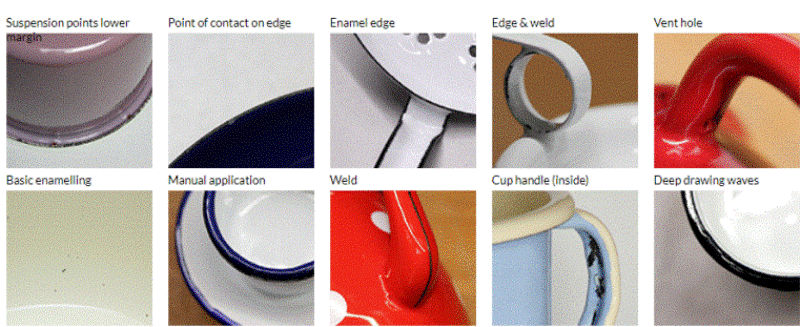
To obtain a perfect finished product, each item would need to be hand finished making it very difficult to produce and bring to market at a reasonable cost.
Some Smaller European manufacturers offer Premium quality enamelware at more than double the price but even in their products Blemishes have to be allowed for.
We recommend Falcon Housewares Enamel products for those that require a product of a fairly consistent level of finish at a more reasonable price.
Powder Coating
Powder Coating should not be confused with enamelware, it is a type of coating that is applied as a free-flowing dry powder which is mainly used for coating of Lightweight metals and Tinware items, in general the product will be a lighter gauge metal than traditional enamelware.
The coating is typically applied electrostatically and is then cured under heat to allow it to flow and form a “skin”.
The powder may be a thermoplastic or a thermoset polymer. It is usually used to create a hard finish that is tougher than conventional paint.